The Thames Bank boathouse.
Thames Bank was a large mansion built in the early 1890s. It had 15 bedrooms, stables, a coach house and extensive river frontage. Its owner Frederick Shoolbred was the proprietor of an upmarket department store in Tottenham Court Road in London and a very wealthy man. The Goring property was his country retreat, as his main home was at Steyning in Sussex. He even bought the Warren Farm estate in Streatley and converted it into his own personal golf course. The boathouse opposite Goring Lock was the largest of three in the Thames Bank grounds. In 1910 it was described as built of wood with a wet bay, concrete slip way, thatched and with a tool room. Unlike Mr Hallett’s building, this was simply a boat store and not a place of recreation. Very likely it housed a steam launch built in Goring by Sam Saunders. In 1922 Mr Shoolbred died and Thames Bank was sold to Mr Frank Strick who was then the owner of the adjacent and slightly less grand Nun’s Acre. Mr Strick was a shipping magnate and like Mr Shoolbred, extremely rich. However he did not stay at Thames Bank for long and in 1929 the property once again came on the market. The sale catalogue gives a very detailed description of the estate. Included as a separate lot, 2 roods 30 perches in area, was a ‘riverside building site with exceptionally fine boathouse (lighted by electricity). The site now forming part of the grounds of Thames Bank would form an ideal situation for a Small Summer Riverside House. It is shaded by mature trees and has separate access from a short road leading from the foot of Goring Bridge.’ According to the catalogue a tiled roof had replaced the thatch and the boathouse was built of timber; it had a wet dock capable of holding a large launch 55-60 feet in length and a concrete floor with a rail runway. In the event the boathouse and its plot were not sold separately and continued to be in the grounds of Thames Bank. The house was occupied by the Ministry of Defence in World War II and became the language school of the English wing of the Belgian Air Force. After the war Wing Commander ‘Digger’ Larkin converted Thames Bank into a prestigious nursing home where many well known people came to be cared for and some to die.
Two into one
The two boathouses seem to have remained separate until 1997/98 when the redevelopment of Thames Bank into an apartment complex took place and some of the grounds were sold off. The Hallett and Thames Bank boathouses were combined into one property and in recent years converted into a luxurious house in beautifully landscaped gardens.
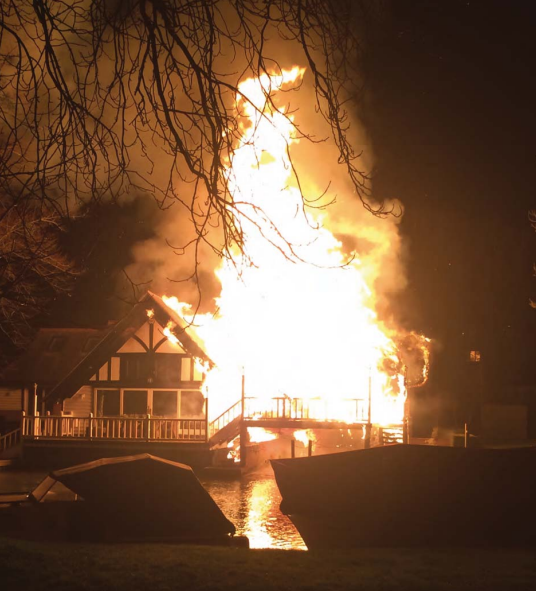
Photo: Jane Stafford
Smoke on the water
Occasionally I go for a late night walk to clear my head after working on the computer. The village is usually peaceful at this time but around 11.45pm on Friday 23 February it was uncannily quiet with no cars at all. The reason soon became clear – police cars with flashing lights blocked both ends of the bridge and there was a fire engine on the bridge. Fearing another accident on the bridge I asked what had happened. The constable told me it was a house fire ‘over the river’ and that nobody had been hurt. I could see no sign of a fire at all! But as I walked home down Thames Road, a pall of smoke, lit by occasional flashes of fire, drifted over the river towards The Swan. The fire appeared to be behind or in the former Sam Saunders’ boathouse now occupied by Royal Mail. Then I could see beyond the smoke and realised it was the lovely Victorian thatched Boat House next door that was on fire. Not easily seen from the bridge it graces the banks of the mill stream at the head of Goring lock. It was surely different 90 minutes earlier, for the Oxfordshire Fire and Rescue Service reported that they had received a call at 9.45pm and that the fire could be seen from Didcot! A little later, the only sounds were of generators powering the floodlights as the fire crews damped down the flames. I’ll warrant that very few in Goring were aware of the drama taking place unless they were at the Unplugged concert in the Village Hall. Next day the early morning sun silhouetted the damaged building through the mist and smoke and we could see that the fire had affected the thatched section and that prompt action by the fire crews had prevented serious damage to the roof of the other half. Indeed some of the interior visible through the windows appeared unscathed by the fire. They were still putting out little flashes of fire and stayed until Saturday evening to be sure. It was a good job that it was not windy and that there was a copious water supply very close by. A fire engine blocked the lane to the boathouse alongside Pierrepont’s and a gazebo had been set up next door by the Saunders’ boathouse to shelter and feed the fire crews. We can only be grateful that nobody was at home. The fire damage clearly showed that the property had, in fact, been two separate boathouses. These were joined after both came into the same ownership some years ago.
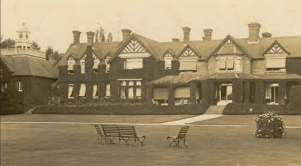
Thames Bank 1924
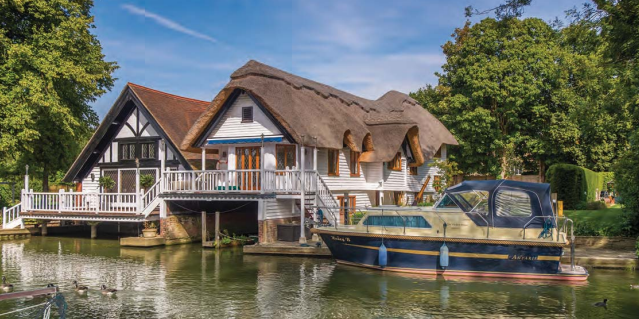
The Boat House - before the fire! Photo: Ron Bridle
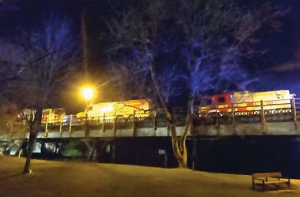
The fire engines parked on the bridge. Photo: Nigel Fountain
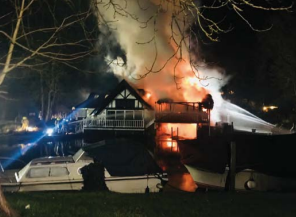
Dousing the flames. Photo: Ollie Fox
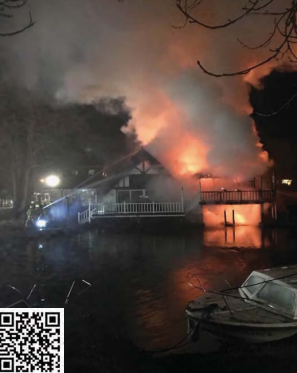
The Boat House ablaze. Photo: Mr Tollett
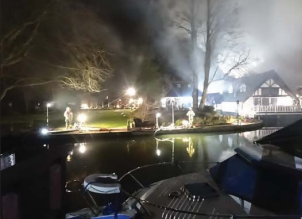
Fire crew setting up the floodlights. Photo: Nigel Fountain
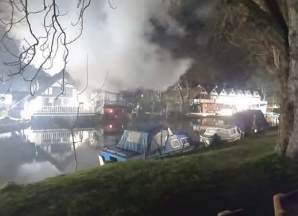
Smoke rising off the building. Photo: Nigel Fountain
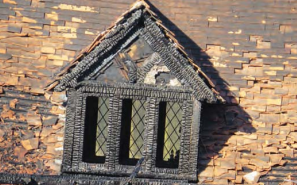
A charred window frame. Photo: Adrian Turner
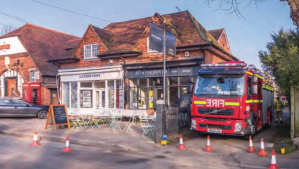
Fire engine outside Pierrepont’s. Photo: Ron Bridle
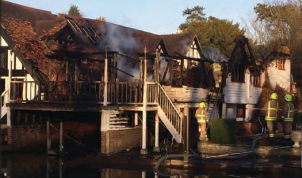
Firefighters assessing the damage. Photo: Eric Walker

Oxfordshire Fire & Rescue Service. Photo: Adrian Turner
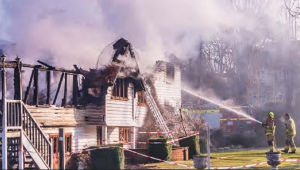
Putting out the last remaining flames. Photo: Ron Bridle
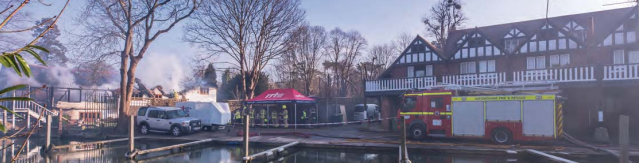
The next morning in front of Saunders’ Boathouse. Photo: Ron Bridle