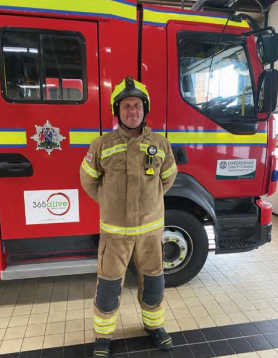
Firefighter Chris Battye at Didcot Fire Station after passing his initial course
By the time I moved to Goring in August 2020, I had been running my own music public relations firm for twenty years. After years spent in record labels, I had set up on my own in 2000 and carved out a niche representing bands such as Def Leppard, KISS, Slash and Rush across the UK and Europe. Apart from weddings and funerals I hadn’t worn a suit in 25 years. My days were spent negotiating with media across Europe and bands, managers and record labels worldwide. There were no set hours and no set roles. My work colleagues joked that we had all become un-institutionalised. We’d gone feral! And then came Covid… I think, like lots of people in the pandemic, I started to think about things outside my bubble. I heard a radio interview with a member of St John Ambulance asking for volunteers to train as vaccinators. I had time, with my business on hold, and ended up doing volunteer shifts vaccinating. I absolutely loved it. Not only interacting with the public (and calming down people terrified of injections!) but also learning. But, with St John’s, you did feel on the outside – doing the odd shift and then leaving the NHS to it. Driving back home one day in early 2021 I passed Goring Fire Station, which is only 300 metres from my house. I’d driven past hundreds of fire stations in my time – the double red bay doors, the drill tower at the back – but I’d never given them a second glance. This time it was different. I went online and within 20 minutes I’d applied to be a firefighter at Goring, with Oxfordshire Fire and Rescue Service. I only told my son as I went through numerous interviews, psychometric testing, a full medical and a day of fitness tests – including testing for my reaction to confined spaces and heights. I was concerned by my age (I was 49 when I applied), but there is no age limit to joining the fire service; if you pass the fitness tests you can apply. I passed the selection process and started my two-week initial training in June 2021. The retained firefighter is effectively a paid, part-time role. Whilst the big cities only have whole time firefighters, the rural counties rely on a mixture of whole time and retained crew to provide fire and rescue cover. Oxfordshire has 25 fire stations – all have a retained crew and six of the stations also have whole time crews. The initial course was two weeks of training at Didcot Fire Station that was both hard and rewarding. The instructors were firefighters with years of operational experience, and they ran us through the basics of ladders, pumping and hoses, road traffic collisions, water rescues and finding our way around the fire engine (known as the appliance). It was a hot summer – often around 30 degrees. I quickly learned that to be a firefighter you need to get used to being hot, all the time! It was far removed from my day-to-day life, but I loved the process. I removed my beard of seven years and even bought an iron! As a 50-year-old man it was the first iron I had ever owned. Throughout the application process and initial training, I had briefly met the crew at Goring. There was a Watch Manager who ran the station, two Crew Managers and seven firefighters. I discovered that the crew work around primary work schedules to make the truck available (to have it ‘on the run’). The officers understand that the crew have jobs and lives and they work hard to make sure the role is flexible. The firefighter gives a certain amount of time per week to the service – my contract is 59 hours per week that I work in and around my full-time job. After the two-week initial training, I came back to Goring as a FFd (FireFighter in development). I had to complete another assessment by the crew at Goring (a ‘Safe To Ride’), where they tested my knowledge of the basics. They must be happy to work alongside me, so they have the final say if I am ready or not. The night of my Safe To Ride the crew paraded outside the station and I was presented with my pager. It felt like a big achievement. Six months before I had no idea that I would now be an operational firefighter. It was two, long weeks before I had my first call out (or shout). The pager started beeping and vibrating on my table at home. The adrenaline coursed through me as I put on my uniform and jogged to my car. From the pager going off we must be on the appliance, kitted up and on our way within five minutes. I made my way to the station for the first of many shouts. As a new firefighter you realise your training has only just begun. As a FFd you undergo a development process which can take up to three years. I have just completed my development after 22 months. The process is feeding you more and more theoretical and practical experience to bolster the effectiveness of the station. One of the key elements of being a firefighter is the use of breathing apparatus – to allow us to work in non-breathable environments (such as a house fire). This is another two-week course where you experience real fires in the fire service